







For many years my family would embark on an annual bicycle expedition from Merricks Beach to Somerville, stopping at (both in chronological order and in order of exponentially increasing quality) the Heritage Balnarring, the Marina Hastings and, finally, Tulsi. Named, as I would later learn, after an Ayurvedic herb native to India and sometimes referred to as holy basil, Tulsi was until recently, owned and operated by Devendra Singh and was always a sensational place to eat, especially with the perspective of having eaten chippies at the Herro within the same afternoon. At some point it was revealed that the same family operated a winery in Red Hill, where Devendra’s wife, Shashi, was the winemaker. The winery put on pop-up dining events from time to time, often hosted by the son of the family and assistant winemaker, Rohit, and once these too became a regular fixture for us, the Singhs cemented themselves in our lives as among the most tasteful tastemakers on the Mornington Peninsula.
I would like to remember what it was like to enjoy the Avani wines before I had learned the language to really describe how they tasted. They felt unusual, in a great way, and some of them certainly looked unusual in the glass. There was a lightness of touch about them, but still with lots of fruity flavour. Kind of savoury, maybe. What struck me then was that everyone at the table, old school and more adventurous tastes alike, seemed to love them.
Probably the most resonant piece of winemaking wisdom I’ve ever heard came from Tricia Byrnes, assistant winemaker at Hurley Vineyard in Balnarring: “It comes from the vineyard,” she said after giving us a taste from one of the barrels. “You can’t make it. But you can ruin it.” Flavour comes from the grapes, so wine is essentially made in the vineyard and everything that happens in the winery is just a process of guiding that flavour and ensuring it evolves in the best possible way. This was an interesting notion to consider at Avani, where the grapes come from a number of different vineyards, all non-irrigated but with different farming practices. During vintage I was struck by how pronounced the differences between the grapes were; everything was of a high quality, no doubt, but the fruit from organic vineyards was not only more flavoursome but also less affected by fungal growth, which was becoming a concern after the early onset of damp wintry weather. Meanwhile, the shiraz grapes from the Avani vineyard, which is biodynamically farmed, were not only pristine, but had, to me, more depth of flavour than anything else that came through the winery - super sweet but spicy, like little peppery lollies.
.jpg)
Avani is a bit of an outlier on the peninsula, where organic and biodynamic farming aren’t common practices. Shashi explained to me the way in which viticulture here is being affected by property prices; in order to afford the increasingly expensive land, many growers are forced to overcrop their vineyards in an attempt to increase wine production, which results in grapes with less concentrated flavour. As a wine region, it’s not necessarily conducive to smaller-scale winemaking and low-yielding vines, and it’s a stark example of the insidious ways beautiful places can erode as a result of their own popularity. Originally from farming families in Northern India, the Singhs bought the property in Red Hill with its established vines in 1998. While the original arrangement was for them to farm the grapes for offsite vinification, Shashi soon developed a curiosity that led her to enrol in a winemaking degree. After some trial and error the vineyard was replanted to shiraz, a variety that accounts for less than 5% of planting on the peninsula, where the climate is cooled by the maritime weather and most growers favour earlier-ripening varieties like pinot noir, pinot gris and chardonnay. But the Singhs are confident that, given the trend of increasing temperatures, their shiraz vineyard will only improve in the future.
In 2021, in addition to the estate-grown Avani syrah and the wines under the label Amrit (Sanskrit: ‘nectar of the gods’), for which fruit comes from neighbouring vineyards in the Red Hill area, a premium pinot noir and chardonnay is also being made with fruit coming from a friend’s farm in Outtrim, Gippsland. While this heralds a new tune for the winery, it marks a reprise for Shashi, who cut her teeth working for legendary winemaker Phillip Jones of Bass Phillip winery in Leongatha. While loyal to the peninsula, the folks at Avani have a certain fondness for the fruits of this area, and seem tethered to the land in spirit. One can even see across the Western Port Bay to South Gippsland from their dinner table above the vineyard, where the wines of Bass Phillip make a regular appearance.
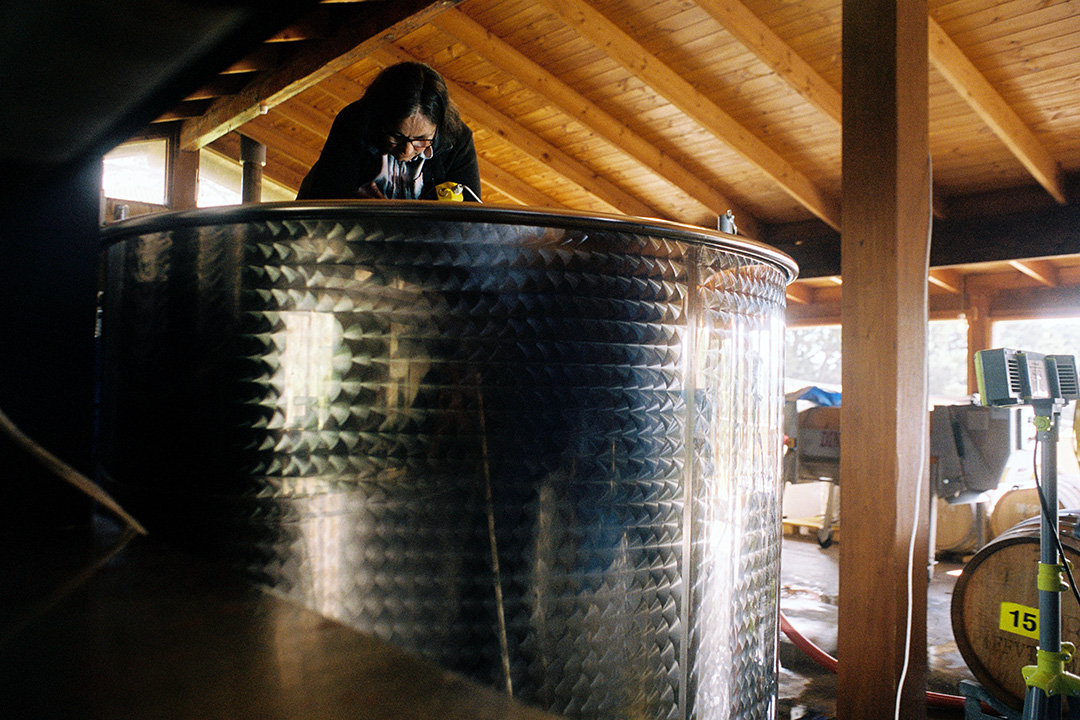
For me, existence during the vintage vacillated between two extremes. On one hand there were crisp morning walks through the vineyard in gumboots and life-affirming notions of country life, and on the other hand there was cleaning the press. Prior to starting at the winery, Rohit joked to me that the winemaking process is “80% cleaning, 15% moving stuff around, and 5% other stuff”. As it turns out, this was very much not a joke, and the process of ‘minimal intervention’ is not as chill as it sounds.
Fortunately, that miscellaneous 5% is engaging enough to avenge all the other activities, and once you can hear the ferments start (as Jamie Oliver would say) blip-blip-blippin’ away, the magic of the process fills the air, and the excitement of seeing wine come to life guides you the rest of the way. The process at Avani involves, in various combinations: steel tanks, old barrels, new barrels, carbonic maceration for the reds, skin contact maceration for the whites, conventional fermentation, saignée, whole bunches and hand-plunging. While Shashi was schooled in the Burgundian approach of Phillip Jones, the team have cited a bottle of Georgian wine drunk in a Melbourne wine bar as being an inspiration for their journey into the more left-of-centre winemaking for which they have become known. There’s an ethos of experimentation but there’s always a baseline of approachability, and the appeal of the cellar door is that there’s always a bit of intrigue but it never goes off the deep end.
At dinner, the Singhs geek out on the nuances of Rhône syrahs, and it is humbling to hear them talk about themselves as students, rather than teachers, of the process. It gives the whole exercise a tremendous sense of vitality. Rohit, who has recently left the business world to work full time at the winery, describes winemaking as “the meeting of art and science.” Shashi, who has studied chemistry and is the only one at the table who truly comprehends what is happening at the atomic level, has such admiration for the process that it takes on a spiritual dimension. The tanks are children and the sulfur is lovingly referred to as ‘the blessing’. While life at the winery is characterised by intensely hard work, the vibe is warm and familial with plenty of toddlers underfoot, and the whole operation is fuelled by a potent combination of dhal, chai and back vintages. What a pleasure.
And — tip — the only thing better than the wines inside are the limes that grow out the back.